For my final project for my Film Theory class, I decided to do a close reading of The Talented Mr. Ripley (1999). During this course, I discovered my love for theory, specifically queer theory and psychoanalytic theory. Rather than write a traditional ten-page paper during the COVID-19 crisis, I thought it would be fun to lay out my findings in the form of a video essay!
Literature Review
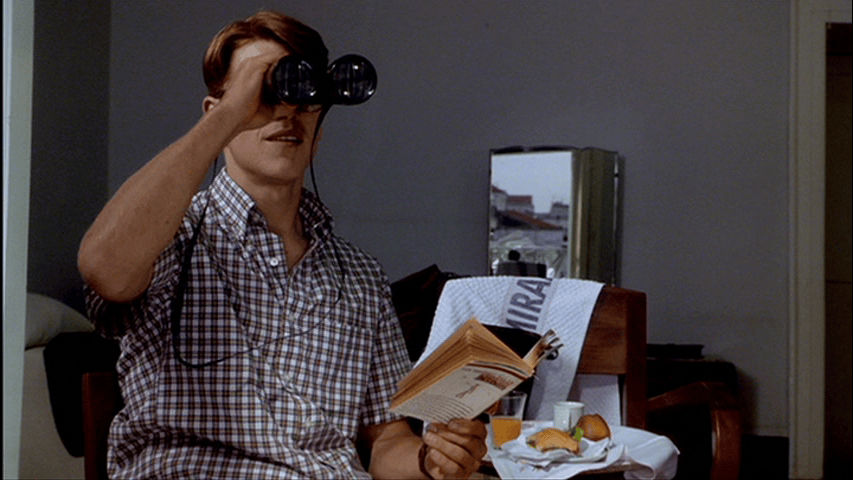
My video essay on The Talented Mr. Ripley (1999) was heavily informed by psychoanalytic studies and queer theory. When I rewatched the film, we had just covered Laura Mulvey’s Visual Pleasure, making the themes of the male gaze and identification easily recognizable and helping me with my analysis. Mulvey’s male gaze theory was the genesis of this video essay and laid the groundwork for the other conclusions that I came to. By observing Dickie, Tom finds pleasure in watching his every move. Initially, it seems quite innocent, as curious as a child watching their mother perform a task. Tom’s fascination with Dickie develops into a narcissistic need to be like him, to identify as him, to be him. It is a way of satisfying his inner desire to be romantically involved with him in this heteronormative society that punishes queer people. Her use of Freud and Lacan’s theories on psychoanalysis, narcissism, and the mirror stage helped to inform my research involving our main character’s actions and thought process. Tom’s main goal in the film initially was to become a member of the upper class by observing Dickie’s lifestyle and attempting to identify with him. His attempts to do so were violently rejected and worked to undermine his existence. By understanding the heteronormative nature of the male gaze theory, I chose to explore how those norms forced Tom Ripley into the closet and drove him to kill.

Because the film is set in the 1950s, the viewer can already understand how heavily enforced the hegemonic and heteronormative ideals were. This fact, alongside the male gaze theory, places wealthy, straight, white men as those with subjectivity— they are given the power of objectifying others, more specifically women. Although Tom is a white man, his lack of wealth and his queerness are two characteristics that hinder his ability to be the bearer of the gaze. He certainly tries to, as there is a plethora of moments where the viewer can see Tom simply observing those around him, specifically Dickie Greenleaf; but Dickie soon enough picks up on the fact that Tom is not straight and does not have money. For those reasons, Dickie believes Tom is incapable of being a part of the upper-class society that Dickie is obviously in.
Homosocial desire was another big theme that I explore, looking at Eve Sedgwick’s introduction in her book, Between Men: English Literature and Male Homosocial Desire. She gave an in-depth analysis of homosocial desire— yearning for “social bonds between persons of the same sex (Sedgwick 696)”— which contributed to the instances in the film where Tom and Dickie spend time with one another, forming their relationship. Tom Ripley is an outsider, but one of his many “talents” is reinventing himself and changing himself to fit into any situation. He does this by intensely observing his surroundings and the people nearby. Just like a chameleon, he adapts to fit in, at least he tries to. He believes that being around Dickie— taking on his interests and quirks— is his one true path to having class and more importantly, subjectivity.
Harry Benshoff’s article from New Queer Cinema influenced the points I made about how the projections of hegemonic ideals, both in the setting of the film and from the film’s audiences, add to the pressure of Tom having to repress his queer desire in order to not be an outcast. Audience members from around the time the film was released were confused by it, and seemed to fixate on Tom’s ambiguous sexuality. He lists four constructions of the queer male identity: “1) being psychologically and socially out, 2) self-consciously queer but socially closeted, 3) psychologically closeted by socially out, and 4) both unconsciously queer… socially closeted (Benshoff 174).” Tom Ripley seems to fall under the fourth construction, as there is no instance in which he comes to a conclusion about his sexuality. Since there is no confirmation from creative directors about his sexuality in the film— the books confirm that he is heterosexual, which is a moot point— the audience is left to question Tom’s sexuality for him, if not along with him (Benshoff 175). The article also discusses the topic of homosexual repression being a precursor to violence, which assisted me in furthering my thesis. I argued that Ripley’s actions as a violent spectator stem from hegemonic ideals that insist he not be the holder of the gaze, therefore not allowed to express his inherent queerness.
What happens, though, when men are the object of another man’s gaze? By using queer theory, we can subvert this theory to understand what happens when we think about male desire and men as objects of the gaze. Queer theory, as defined by April Callis in her essay on bisexuality, is all about breaking down hegemonic beliefs and “queering them”— or questioning why they are in place and what makes them the norm. This essay provides a deep review of how queer theory came to be; Callis also reports on the fact that queer theory has historically been quite binary, ignoring fluid sexualities and identities, as well as other intersectional conversations, such as sexuality and race or class (Callis 216). Understanding queer theory aids in understanding how these hegemonic ideals are the norm and punishes those who do not align with these expectations.
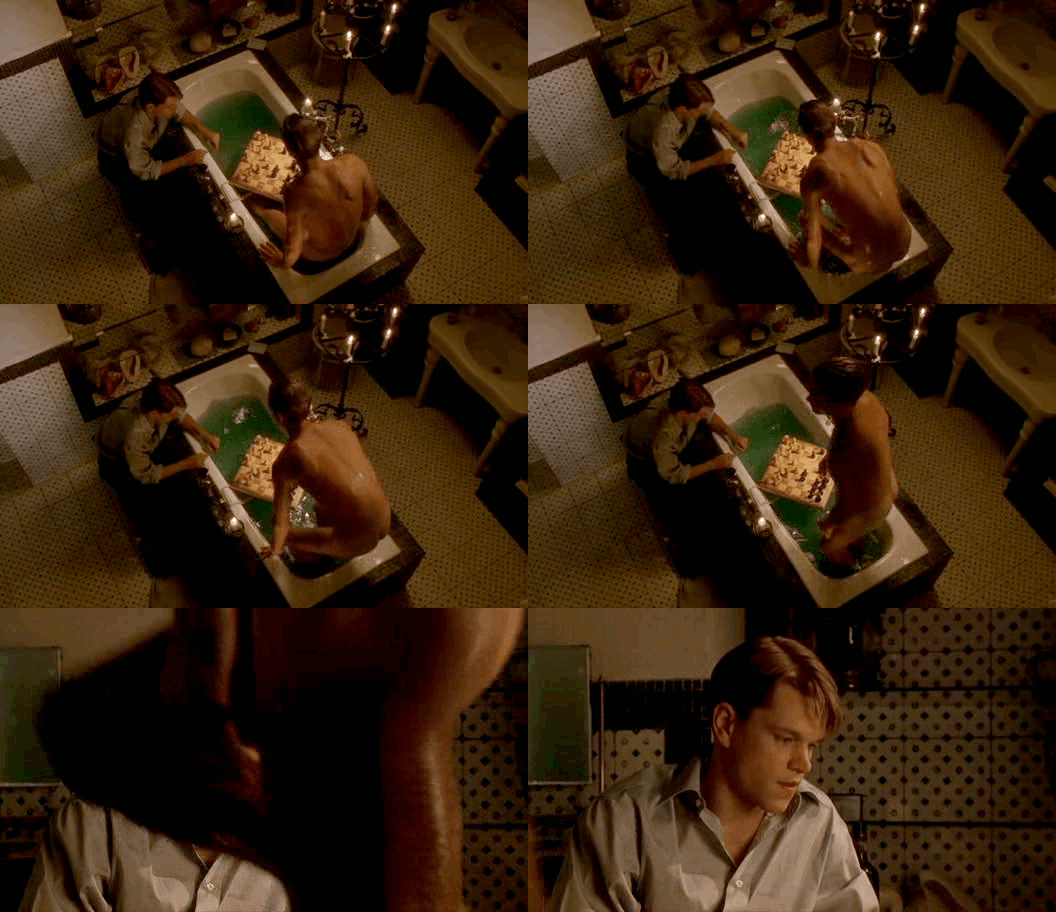
The most powerful moment in the film in regard to queering the male gaze was the bathtub scene. In the bath scene, arguably the most homoerotic scene, Tom is playing a game of chess with Dickie as Dickie takes a bath. There is sensual jazz music playing, the room is candlelit, and the two answer personal questions about one another, as if they are courting each other. The close up shot from above as Dickie smokes a cigarette aligns the viewers gaze with Tom’s gaze. We see what he sees— an intimate and private view of Dickie. Knowing Tom, he makes the situation awkward by asking if he can get into the tub. His eyes are desperate for Dickie’s response, fearing that he might have mucked everything up. Dickie says no, and in a quick moment, we see Tom’s reflection in the water— a mirror— and now Dickie is in charge. He allows himself to be looked at through the mirror as he leaves the bath— although he is being objectified, he still has subjectivity. He gave Tom permission to look. Tom does look, of course, taking what he can get. That pleasure is quickly cut off as the camera cuts to Dickie looking back at Tom. Ripley looks away, ashamed, no longer objectifying Dickie. Men can be objects of desire, but are never fully objectified. He can still have subjectivity. That is what is queer about it.
Another moment in which Dickie rejects Tom’s attempt at bearing the gaze is when Tom is caught trying on his friend’s clothes. This shot where Tom is behind the mirror and Dickie is in the reflection is an example of Tom obviously trying to be like Dickie— if not be Dickie. Tom, however, is being criticized and his attempt to be someone he is not is rejected. It is an interesting moment of the mirror stage, a theory Mulvey shared using Freud and Lacan’s theories on narcissism and psychoanalysis. Tom was attempting identification with the image he was seeing, and for a moment the audience can see it as well; but Dickie, now the bearer of the gaze, thus the dominant person in the room, denies Tom’s wish to be like him. He basically says, “No. You’re not allowed to be me.” Tom cannot accurately identify who he is.
This rejection of identifying with an image is the catalyst for Tom’s violence and aggression towards the three men he kills in the film. In alignment with Lacan’s “death drive” he was denied the opportunity of finding out who he actually is and was driven to aggression and violence towards others. Throughout the film, Tom is essentially like a child looking into a mirror, hoping to connect with his “ideal ego” that he has worked so hard to replicate (Woodward 75). More than one person tells him that he cannot be that complete image he so deeply craves. It is a rejection that hits him deep in his core, and in tandem with the repression of his queerness, he has no choice but to act violently— to kill— in order to release his frustration. It goes to show how dangerously oppressive these hegemonic views are, even to those who should be in power according to its logic.
After feeling so detached from Dickie, the two decide to take a boat out into the ocean in San Remo. There is a bird’s eye view shot of the boys in the boat. It is just the two of them, and they are so far out that no one can see or hear them – the perfect opportunity for secrets to come out. Anxiety rises as Dickie recklessly steers the boat, and something stirs between the both of them to say whatever is on their mind. They even look like one another at this point, dressed in similar garb and hair bleached by the sun. Tom shares his plan of coming back to Italy on his own so that the two of them can live together year-round. It is the perfect domestic life for Tom, but Dickie immediately knows that that simply cannot work out. Dickie then shares that he and Marge are going to get married. According to Tom’s observations, he believes Dickie would not be happy being married to marge because he constantly seeks attention from other women.
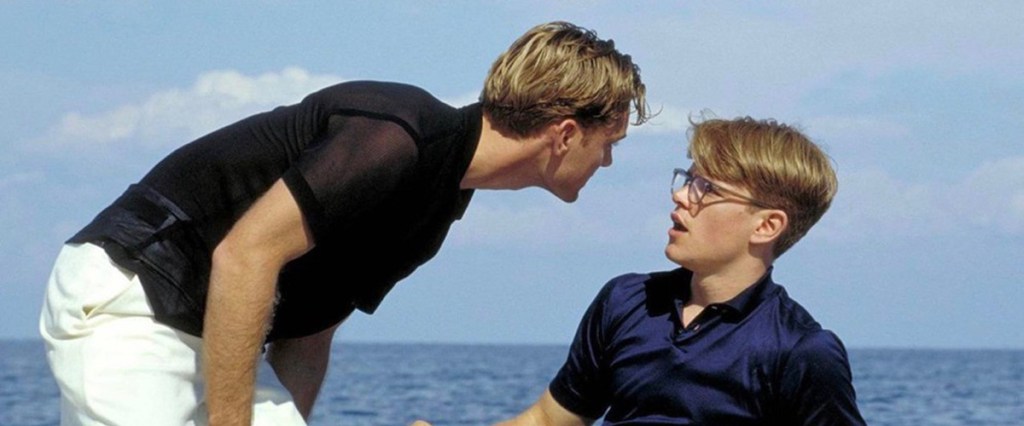
It is reminiscent of a break up. The moment in which Tom is woken up from his reverie and snapped back to hegemonic reality. Tom looks out into the vast ocean in disbelief as Dickie spits insults about him, how he can be boring and a leech. The camera switches back and forth between close up shots of the two men, highlighting Dickie’s annoyance and Tom’s emotional frustration. Tom fully believes that the romantic feelings he has for Dickie were reciprocated. His true feelings are coming out in a fit of frustration, and it hurts especially because Dickie is ending their relationship to get married to a woman. How could Tom compete with that? But society shames homosexual desire, and that causes these repressed feelings to bubble up and wreak havoc on the surface. That explosion of internalized emotions is fatal. The “break up” finally ends with the camera panning over Tom’s mess— he is lying with Dickie’s bloody corpse around his body. It is the only moment in the film where Tom actually gets romantic affection from Dickie, but it’s too late. Dickie’s death scene is brutal and difficult to watch, similar to Adrian Lyne’s Fatal Attraction (1987) ending— extremely bloody and an explosion of rejected feelings.
These scholarly sources— though they were quite dense and I found moments in which I felt I was biting off more than I could chew— greatly aided in developing my flow of ideas and helped me understand Tom Ripley’s character. In the end, it was evident that the constant rejection and lack of subjectivity in a hegemonic world fueled Tom’s violent tendencies. He found that more lies and violence were the only way to fix his careless errors, but they only added to his mess. It was fascinating to apply those psychoanalytic theories to the mind of a desperate murderer. I am now left wondering how I feel about Ripley’s character now that I understand where he is coming from. Should we feel bad for him? Is he really to blame for his actions? Is anyone to blame at all? I suppose these were questions I could have explored further in my video essay, but I took it more as an opportunity to display my findings in a creative and engaging way. Overall, I am thrilled that I was able to apply complicated theories that I learned in and out of class to a movie that I really love.
Works Cited
Benshoff, Harry M. “Reception of a Queer Mainstream Film.” New Queer Cinema: A Critical Reader, edited by Michele Aaron, 2004, pp. 172-186. https://www.jstor.org/stable/10.3366/j.ctvxcrw2f.21. Accessed 25 April 2020.
Callis, April. “Playing with Butler and Foucault: Bisexuality and Queer Theory.” Journal of Bisexuality, vol. 9, no. 3-4, 2009, https://doi.org/10.1080/15299710903316513. Accessed 17 April 2020.
Maslin, Janet. “Film Review; Stealing a New Life, Carnal, Glamorous, and Worth the Price.” New York Times, 24 Dec. 1999,https://www.nytimes.com/1999/12/24/movies/film- review-stealing-a-new-life-carnal-glamorous-and-worth-the-price.html.
Mulvey, Laura. “Visual Pleasure and Narrative Cinema.” Film Theory and Criticism: Introductory Readings, edited by Leo Braudy and Marshall Cohen, Oxford University Press, 2016, pp. 620-631.
Sedgwick, Eve Kosofsky. “Introduction.” Between Men: English Literature and Male Homosocial Desire, edited by Carolyn G. Heilbrun and Nancy K. Miller, Columbia University Press, 1985, pp. 696-712.
Woodward, Kathleen. “The Look and the Gaze: Narcissism, Aggression, and Aging.” SubStance, vol. 18, no. 1, 1989, https://www.jstor.org/stable/3685030. Accessed 7 May 2020.


Leave a Reply