In typical Black Mirror fashion, the second episode of season four titled “Arkangel” follows a mother and the lengths she goes to protect her daughter from the real world. After Sara, Marie’s only daughter, goes missing for a few hours, Marie makes the executive decision to implant a monitoring system in order to ease her mind.
Appearing painless to three-year-old Sara, the quite invasive monitoring system gives her mother access to much more than her whereabouts. The doctor hands Marie a tablet with the Arkangel system and shows her its features: access to Sara’s vitals, her location, parental filters, recent memories, and the creepiest feature— an optic feed. Yup, Sara’s eyes were now cameras and Marie could see what she sees from her tablet screen.
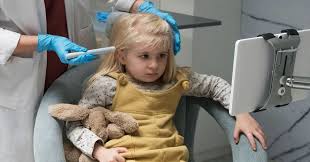
As we watch little Sara grow up, we get to see just how useful and harmful the Arkangel system becomes. It is reminiscent of other parental supervision apps that parents can plant onto their children’s phones in our reality. Director Jodie Foster dives into the uncanny by making a biotechnical version of what we’re familiar with.
We can think of the Arkangel system as a digital platform, like Facebook or Google. On a digital platform, there are many moving parts to make the user experience as engaging as possible. There are features, embedded tools that serve as the platform’s intended functions; affordances, the perceived possible actions based on a certain platform feature; algorithms, outputs based on input; and interfaces, the part of the platform’s design that you see and interact with.
Ultimately, platforms take a bunch of content and host it on their complex digital infrastructure designed to collect, package, and sell user data. They are connected to a multitude of other platforms thus not working alone, but in conjunction with other platforms in their ecosystem.

Every platform (unless you’re Parler) heavily depends on selection and content moderation techniques to create the optimal experience for every user. We can think of Marie as a content curator for her daughter through the Arkangel system, and while she thinks she knows what Sara needs, not every algorithm is perfect for every user.
parental filters as content moderation
Selection, commonly known as content curation, a platform mechanism that makes editorial decisions for what a user sees and experiences on the platform. It’s essentially controlling how a user experiences the online space, can skew their view of the world around them, and place them in a bubble.
An example of this is the explore section on Twitter. There are two tabs to really focus on: the Trending tab and the “For You” tab.
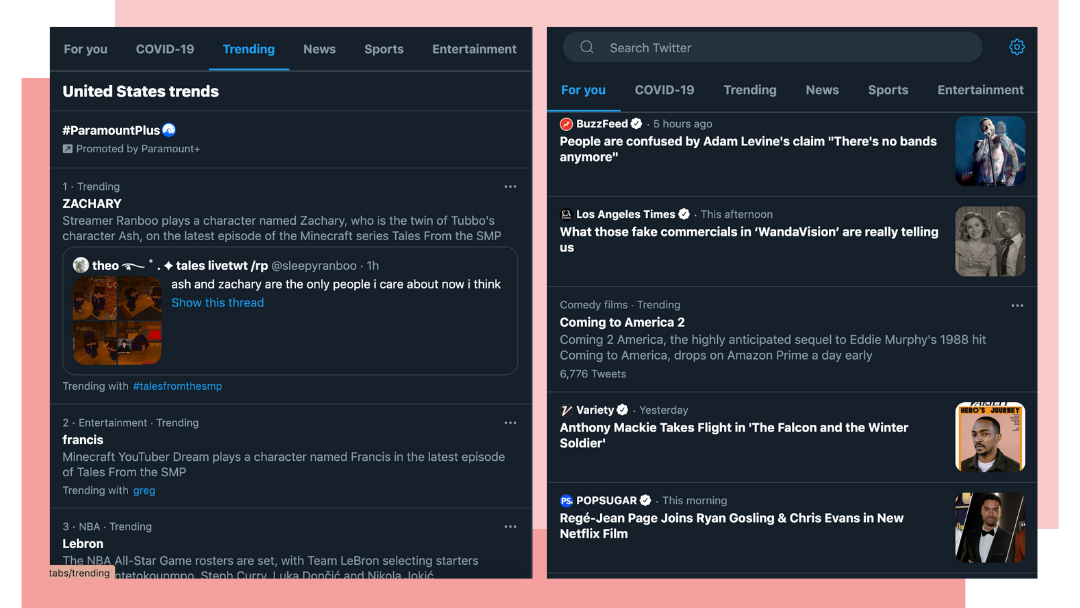
On the left, I have the trending tab which is comprised of the most repeated/viral phases and stories currently. This tab looks the same for everyone and is relatively generalized. The right screenshot shows my “for you” tab. These trending phrases are examples that Twitter has selected specifically for me based on my history and the data they have collected from me that they believe I would want to see.
On a superficial level, I don’t really care about the global trending tab – it’s usually filled with COVID-19 news and I could use some… distance from that. The for you trending page is more often than not filled with actual content I would want to see. From celebrity news, to Marvel, to political issues. But every now and then I make sure I take a look at what’s happening outside of my bubble.
Sara’s mother has similar power. She was noticing that the loud, angry dog next door would always bark aggressively at Sara when she was walking to school. To make that less daunting for her daughter, Marie takes the liberty of adding a parental filter to Sara’s monitoring system. We get to witness the barking dog turn into a muffled brown pixelated figure.
Sara was unable to see blood, she couldn’t watch school fights, she never gets to see pornographic images. Seems harmless, right?
Over-Monitored content becomes problematic
As Sara begins to get curious about the censored content she could not see, I noticed that she was becoming a bit desensitized to the filtered content. A boy from school, Trick, even tries to verbally describe explicit content and his voice would get blocked out. She gets so sick of being sheltered that when attempting to draw a violent scene in her sketchbook, she ends up stabbing herself with a pencil to test if she could see her own blood.
In a New York Times opinion piece about the connection between mediated violence and actual violence, they explained studies that showed a small but significant link. While exposure to violent media was not the only factor is significantly violence actions in real life, it can have adverse effects.
In Sara’s case, it is the lack of exposure to sensitive content that causes her to act out and self-harm. So, her mother takes off the parental filter and now Sara has unfiltered access to the world for the first time since she was three.
a massive invasion of privacy
Most folks know that privacy is a hot commodity online and is never really guaranteed. No one ever reads the user agreement before creating a social media account, and can you really blame them? It’s filled with confusing jargon, way too long, and will likely screw over users anyway. Which is a shame, because policies surrounding privacy and data should be laid out clearly for users before they agree to anything.
Sara definitely did not even have a chance to read any form of user agreement before getting the Arkangel system chipped in her brain. She makes it well into her teenage years without her mother monitoring her, and it isn’t until Sara decides to go somewhere without permission that Marie digs out the tablet that she had stashed away in the attic so that she could track down her daughter.
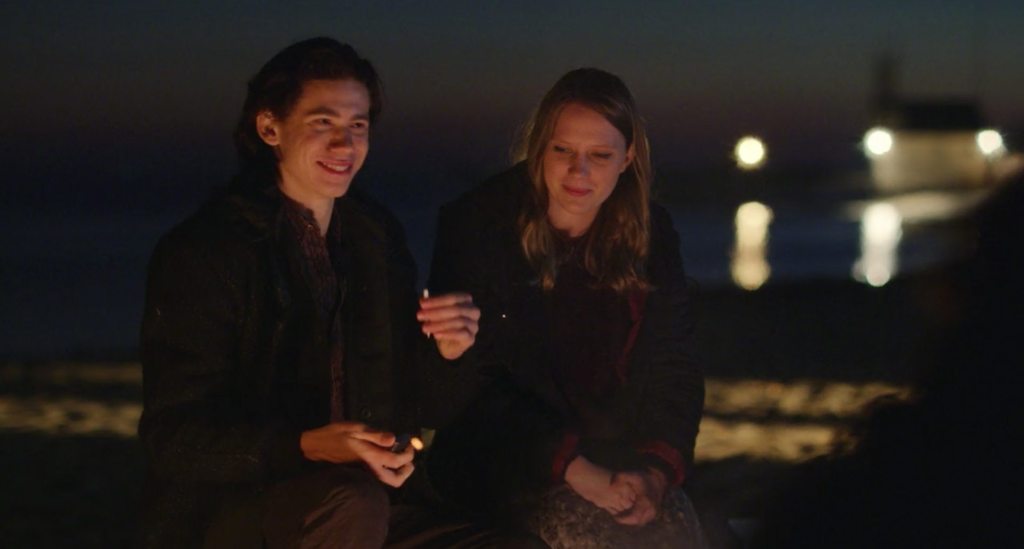
Marie, however, does not just stop at checking Sara’s location. She decides to peer into the optic feed, so she can see what Sara is seeing. Horrified, Marie watches as a boy climbs on top of her daughter and they proceed to have sex. If that is not the biggest invasion of privacy, I don’t know what is.
Remember when I mentioned that Marie could monitor Sara’s vitals? While Marie seemed to use this information to make sure her daughter was getting all the nutrients she needed in her daily smoothies, the final straw was the alert that Sara had gotten pregnant.
We watch Marie crush an emergency contraceptive pill and spike Sara’s smoothie with it. Not only does Marie learn about the pregnancy before Sara does, she’s the one who acts. She had access to crucial data and did what she saw fit.
Whether we like it or not, we by default give digital platforms access to our data and they are rarely transparent about what they choose to do with it. On most social media and digital platforms, the default is to be public. To relate it back to Twitter again, their terms of service allows them to track your IP address, aggregate click statistics to package into sellable data, and even keeps user data up to 30 days after deleting one’s account.
To reiterate, nothing is ever really private, and we have to go out of our way to take back power from platforms that exploit user data.
acting out in the end
Sara eventually puts together that her mother starts using the Arkangel system again after the pregnancy incident. The nonconsensual termination, the threatening of her boyfriend, and the overall helicopter parenting drives Sara mad. She takes the tablet and bashes Marie’s face in a fit of rage. Marie wakes up hours later, notices Sara has run away, and ultimately is unable to track her down since the discontinued Arkangel tablet is destroyed.
I genuinely believe that Marie had Sara’s best interest in mind, but dare I say some good old communication would have sufficed. Every parent wants their child to grow up to be decent humans, but unfortunately extreme governance can be detrimental.
The only feature of the Arkangel monitoring system I found to actually be helpful was the location tracker, and even then, Marie still managed to go overboard. And what really messed things up was that she did it all in secret. Sara had no say and did not consent to any monitoring at all. Three-year-old Sara could not weigh in on the decision to plant a tracker in the side of her head.
I know it’s just a Black Mirror episode and it’s supposed to make us think about the systems we have in place, but we definitely can pull some valuable lessons from the anthology series. Mother doesn’t always know best.


Leave a Reply